How the Leaderboard Works
Every solo round you play against Lothar lands on the leaderboard. Skat and Ramsch get a board each, so a Ramsch specialist is never buried among Skat players. Tables with friends keep their own running score and stay off the board.
Want to see where you stand? Open the live board.
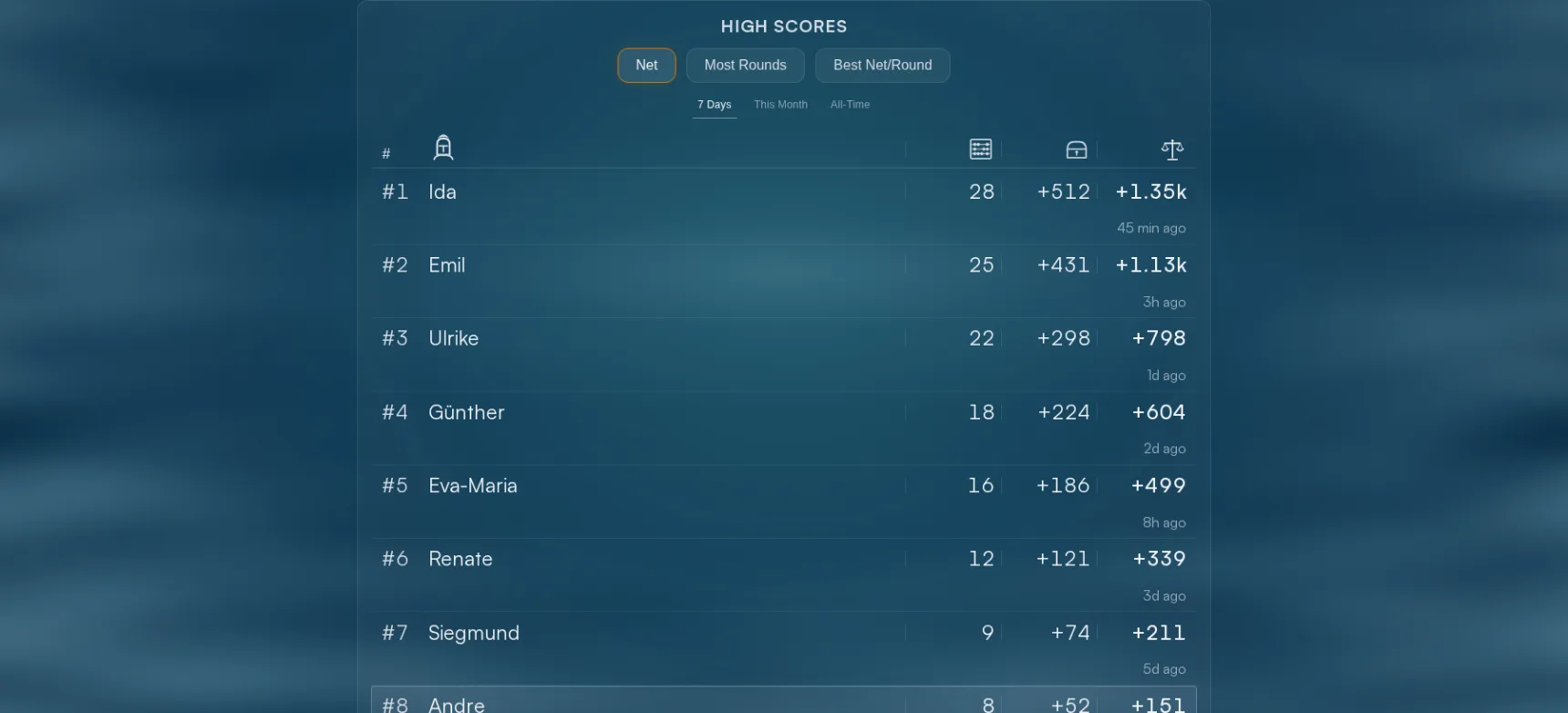
Net: The Number That Ranks You
The board adds up what each seat has scored over the rounds it counts. Your Net is your own total doubled, minus the other two: with 120 to you, 60 to one opponent and 18 to the other, that is 2 × 120 − 60 − 18 = 162. Run the same sum from the other two seats and they come out at −18 and −144. All three always add up to 0.
Your raw score says how well you played. Net says how well you played against this table: how far ahead or behind you are against each opponent, added together. Win cheap rounds while your opponents win the big ones and Net ranks you honestly lower, which is exactly what a leaderboard should do.
Three Ways to Read the Board
Three tabs, three different questions. Net is the standings: who has taken the most off the table. Most Rounds is the stamina board: who has simply played the most. Best Net/Round is efficiency, your Net divided by the rounds behind it, so a short sharp run can outrank a long grinding one. The merchant's scale marks that average here and everywhere else in the app.
When two players tie on the number a tab sorts by, the board falls back through its other numbers until one of them differs.
Three Windows, Three Races
Every board comes in three windows. 7 Days counts only the rounds played in the last seven days, so a newcomer can top it inside their first week. This Month runs on the calendar month and starts over on the 1st, without erasing anyone's career. All-Time is the career record itself. When a month closes, its final board stays: every past month from July 2026 on has a page of its own, one click back from the live board.
Your Name on the Board
You are on the board from your first round. The board lists the top players in each window, and your own row shows with your rank whether or not you are among them, in every window you have played rounds in. A window you sat out has no rank for you, because nothing of yours is in it.
Until you pick a name, nobody but you sees that row: the rank on it is where you would stand publicly. Pick a name in the start screen's name slot, and that is the name the public board shows you under. Register it with a password and your board travels with you to any device.
What a Row Holds
Tap any row and it opens. Inside is that player's run panel: the summary, the charts, and how the three seats stand against each other, all scoped to the view you are in — a 7-day board opens a 7-day panel.
On the Skat board a records band sits above all that, scoped the same way, one row for the rounds played as declarer and one for the rounds played as defender: which game types came up in that role, wins and losses, and four feats. Hand and Ouvert count games you declared and won that way. Schneider and Schwarz sit on both rows, achieved as declarer and inflicted as defender.
A Ramsch row opens the same panel without the band. Ramsch knows no declarer, so there are no role records to show.
Where to Find It
The board greets you on the start screen once you have played a round. Mid-game, the pause menu's High Scores entry opens it over your hand without disturbing it. And it has a page of its own, at /leaderboard, that you can send to anyone.
The victor's dais: a stepped podium with a pennant planted on the top step, the app's mark for the leaderboard.